.png)
Return to Berlin


I wasn’t as excited about this travel adventure as I usually am. Berlin was the first place I lived after graduating from my English degree, and I’d fallen hard for it. Returning twenty years later with a family in tow, there were parallels with the novel living there had inspired. My eldest son was now fourteen, the same age as Francesca, the protagonist in my story. The same tensions that had sparked the opening scene to Saving Francesca Maier more than two decades previously could be felt at Berlin Brandenburg airport, where the newly implemented biometric checks for non-EU travellers were experiencing teething problems.
‘I’m sorry,’ said the border officer, who looked like he was nearing the end of an interminable shift. ‘My screen keeps freezing. It’s been like this all week.’
‘Kein Problem,’ I replied, tugging my ossified German awake and placing my hand down for my fingerprints to be taken for the third time. I thought fleetingly of the bureaucracy my move to Berlin had necessitated and how even then I’d recognised how my path had been smoothed by the good fortune of being a citizen of a fellow EU country.
Still, my mood on the flight from Edinburgh had been buoyed by a particularly charismatic German cabin-crew member. He spoke with a wryness and a hint of rebellion. ‘No matter if you’ve more than one small bag with you, whether acquired at the airport or before, all must go under your seat and not in the overheard lockers unless they have been paid for.’ (I breathed a sigh of relief that our inevitable overspill would not be subject to surcharge.)
Berlin had just experienced the coldest January in sixteen years. Accordingly, we were kitted out with snow boots, hats – and to some derision from my husband, single-use handwarmers, an impulse purchase from the local pharmacy. As he’d predicted, I brought them home again after the trip. We were lucky the temperature had climbed a few degrees and also that some salting of the paths had been permitted. (Berlin had been in a grip of a salt-war debate that had only recently thawed. De-icing salt had been banned in the city for years for environmental reasons, partly because it is known to attack tree roots; hospital admissions for falls that winter had been testing the ban and provoking heated debate.) Besides that, the public transport and all the buildings we visited were kept at toasty temperatures, so we’d little need of the last-minute snow haul and soon regretted the boots.
Entering the impressive Hilton Ku’damm, chosen for its family friendly interconnecting rooms, I tried not to gasp at spending more in a weekend as a tourist now than I had in a month as a trainee. (Though I had felt rich on my Azubi [trainee] salary, with my friends, subsidised travel pass and five-Euro legendary brunches.) I recalled my acute excitement at discovering the German tradition of the 13th pay packet in time for Christmas.
I recognised too the luxury of having had eighteen months to explore the city. What pleasure to be able to languidly discover a place in time. No hurry to view the big hitters. I’d stumble across the landmarks as I made my own history in the city, with new friends or colleagues, and return when family or friends visited me from the UK. In this 2026 visit, I’d meticulously researched a three-day itinerary. Places I’d visited twenty years ago were now considered dated or out of fashion, so Tripadvisor and Reddit told me. (The museum at Checkpoint Charlie, in particular, had been overshadowed by more modern and immersive museums.) I contemplated how many fewer voices I’d listened to back then, forging my own path in the city, trying things out. The internet had less of a hold on the world, then. Less of a hold on me. In fact, I’d researched far less about the city before accepting a job and moving there than I would for any short city break these days.
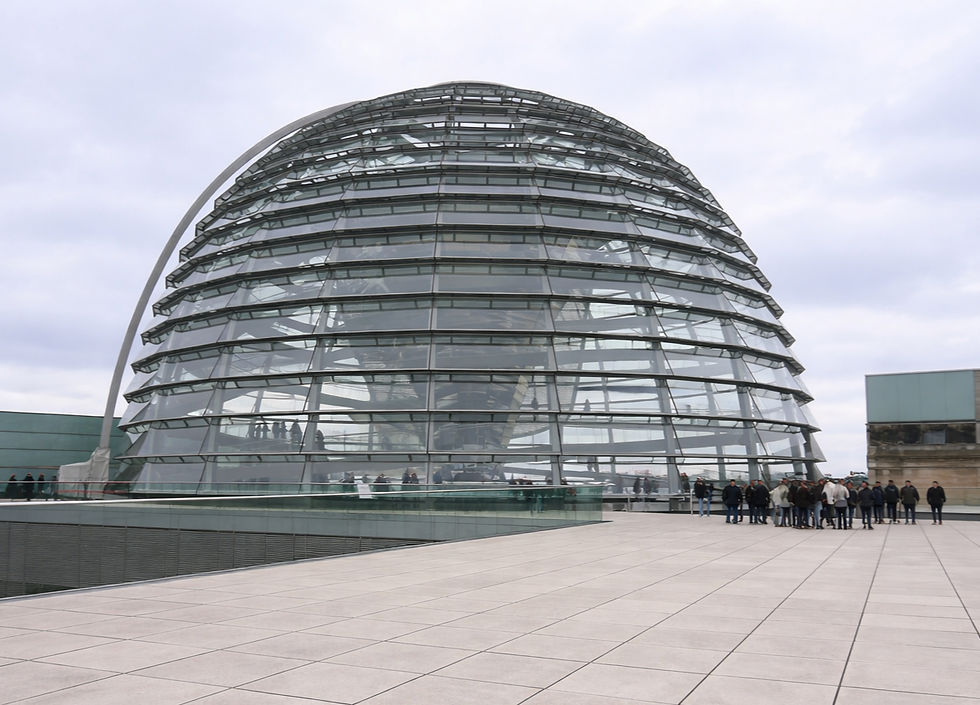
Our itinerary for February 2026 included: a trip to the glass-domed German parliament building, the Reichstag, for getting our bearings via the impressive free tour; the delectable Rausch Schokoladenhaus with the most delicious morsel I ate that trip – the passionfruit tart. (I definitely hadn’t visited anywhere so fancy in my trainee years.) The labyrinthian Dussman bookshop. Yadegar Asisi’s Panorama at the Pergamon Museum, the most breathtaking museum experience of my life. One we’d almost missed, trying to find it on the city’s Museum Island too close to closing time in fog and rain and failing to spot the huge sign suspended above us. I can only thank my son’s perseverance in suggesting we returned the next day to try again.

The 360 degree panorama of the ancient city of Pergamon on the west coast of Asia Minor transports visitors to the year AD 129. The experience is like being inside an immersive theatre set, as visitors climb a platform to view the panorama at different levels, with the light and sound changing as the scene moves through day and night. A truly astounding exhibition. So good we sought out Asisi’s Wall panorama afterwards, showing a segment of the Berlin Wall and the subtle differences between East and West. We needed to bring more of our own knowledge of world events to this exhibition, but sitting on the rough board platform listening to the voices of Berliners from either side of the Wall was profoundly moving.
In a small room before we left the museum, we watched Asisi’s testimony of his move from East to West Berlin. He spoke of how quickly one can become used to division, of how the charm of the West had fallen away after his escape from East Berlin, of the dehumanising impact of the wall and the provocative acts of those who felt invisible. (In the footage, he revisited a friend’s flat situated on the West side of the wall, whose windows had looked out onto the homes of East Berliners. He recalled how although both sides could clearly see one another, in everyday life there was little acknowledgement of this, except perhaps that the East Berliners into whose lives he could peer became increasingly provocative, performing private acts in full view of the homes on the other side of the wall.) He spoke too of a pride in being part of an experiment during his time in East Berlin, of how parts of the way they lived then have become what many aspire to now. His words were deeply affecting.

After this, a stop for a (very) late brunch at neighbourhood cafe Mattea (my children marvelled at their glass straws) and then on to the Urban Nation gallery, which celebrates Berlin as the street-art capital of Europe. Here, alongside eerie artwork of a hand emerging from the gallery’s vent we watched mesmerising footage of a man reclaiming space by painting or otherwise covering over promotional posters in public areas. I’d long thought how busy our public spaces can be with commercial messaging… could I dare to join the movement?
Leaving, I spotted a message in the visitor book. Berlin is my Valentine.
Besides the frenetic pace of our sightseeing, the other big change was that I saw more danger now. Walking back on the Kudamm, the honking and revving of cars was boisterous. A wedding party, perhaps. Or was it something more sinister? These were anxious times, and I had to school myself to stop counting the Polizei with their guns.
Berlin’s ancient U-bahn network transported me in more ways than one. Underground, the same small screens as I had watched at twenty-one brought entertainment or news into the carriage. A band of buskers got on, and people looked away. It could have been twenty years ago. It could have been today.
Perhaps my ambivalence in the months before my return to Berlin came from the pressure to plan the perfect trip, or perhaps a worry that the city of my memory was no longer there, that the first city I had loved no longer existed.
And it was true, there were some things I couldn’t find. The Mexican pizza I’d craved from afar, the 5-Euro brunches, the particular kind of baguette I’d often picked up at the station on my way home from work… the people I’d shared those eighteen months with, they were lost too. Perhaps careless of me in the years that had spawned Friends Reunited and multiple varieties of social media, I was in touch with no one from that era of my life. An online search told me the family I had au-paired for had moved to Vienna.

Still, I rediscovered the city through the eyes of my children, who were generating their own formative memories, no doubt of donuts from Brammibals, glass straws and mastering the transport system quicker than I’d ever managed.
If only we could collect all the things we’ve loved past and present and keep them close. My brief encounter with the city overlaid new memories with old, like tracing paper where you can never quite get the two images to line up perfectly.
Berlin: my recommendations. If you are visiting Berlin, I wholeheartedly recommend the Pergamon Panorama exhibition, Rausch Schokoladenhaus and a Reichstag tour… be sure to book these last two well in advance of your trip.

Claire Wingfield is the author of Saving Francesca Maier and 52 Dates for Writers. She also works as an editor and literary consultant, often assisting authors with publishing their work. See www.clairewingfield.co.uk for information about her editorial and publishing support services for writers.


Comments